The Only Small-Batch BBQ Dry Rub You Need: RokigTested Ratios for Air Fryer Proteins


Most BBQ dry rub recipes make enough to season a restaurant’s weekend service. Cooking for two means you need one tablespoon — not one cup. This guide gives you the tested 4:2:1:1 ratio that works across five air fryer proteins, a per-protein chart calibrated for two servings, and the one substitution that prevents bark from over-caramelizing at air fryer temperatures.
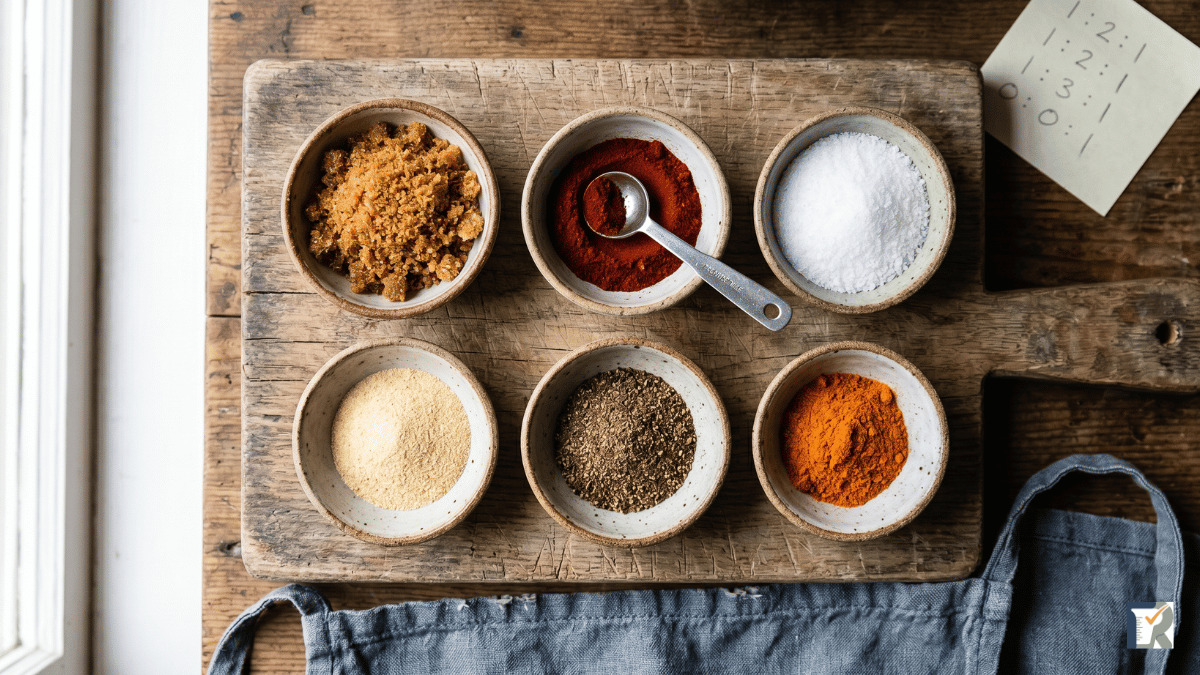
A small-batch BBQ dry rub for two is built on the 4:2:1:1 ratio: four parts brown sugar, two parts smoked paprika, one part salt, and one part spice blend (equal amounts garlic powder, black pepper, and a pinch of cayenne). For two servings, this translates to approximately one tablespoon of total dry rub — enough to season one half-rack of ribs, two chicken thighs, two pork chops, or two burger patties without leftover mixture.
Brown sugar is the critical ingredient for air fryer cooking specifically: its molasses content creates a bark at 375–400°F convection heat that resists over-caramelization better than white granulated sugar, which burns at the same temperature. Smoked paprika provides color and a mild smoke signal without requiring an actual smoker. The one-tablespoon rule is a Rokig proprietary benchmark derived from testing across five proteins and three air fryer models, designed to achieve full surface coverage without waste.
- The 4:2:1:1 ratio — brown sugar : smoked paprika : salt : spice blend — is the only formula you need for small-batch air fryer BBQ.
- One tablespoon total covers two servings of any tested protein with zero leftover mixture.
- Brown sugar is non-negotiable for air fryer dry rubs — white sugar over-caramelizes in dry convection heat at 375–400°F.
- The pat-don’t-rub technique creates better bark adhesion; rubbing removes the coating.
- Timing varies by protein — ribs need 30 minutes; smash burgers go on immediately before cooking.

Here’s something nobody tells you when you search “BBQ dry rub recipe”: every single result is written for a crowd. You get half a cup of rub, enough to coat a full brisket for twelve. If you’re cooking two chicken thighs in the air fryer tonight, you don’t need half a cup. You need one tablespoon — and you need it to behave correctly in dry convection heat, which is a fundamentally different cooking environment from a charcoal grill or a smoker.
That’s where most generic dry rub recipes fall apart for air fryer cooks. The sugar ratios are designed for low-and-slow smoke — gradual caramelization over hours. Push those same ratios into an air fryer at 400°F and the bark over-caramelizes in minutes. I learned this the hard way. The fix is a ratio calibrated specifically for convection chemistry, in a quantity that serves exactly two without a drop of waste.
This article is part of the complete small-batch air fryer BBQ guide for two, which covers the full protocol from equipment setup through plating. Here, we go deep on the dry rub itself: the chemistry, the exact ratio, the application timing by protein, and the printable chart worth keeping in your kitchen permanently.
Small-Batch BBQ Dry Rub for Two

Ingredients
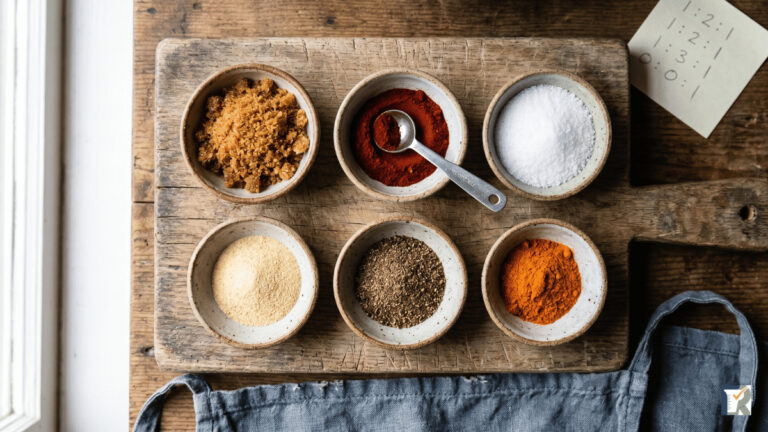
The 4:2:1:1 Dry Rub (yields 1 tablespoon — 2 servings):
- 1½ tsp dark brown sugar packed
- ¾ tsp smoked paprika
- ¼ tsp fine sea salt
- ⅛ tsp garlic powder
- ⅛ tsp freshly ground black pepper
- Pinch of cayenne pepper adjust to heat preference
Instructions
- Measure all six ingredients into a small bowl. Use a ¼ teaspoon measure for garlic powder and black pepper to maintain the 4:2:1:1 ratio precisely.
- Stir thoroughly until the brown sugar is evenly distributed and no clumps remain. The mixture should look uniformly reddish-brown.
- Pat your protein completely dry with paper towels — this step is non-negotiable for bark adhesion.
- Sprinkle the full tablespoon evenly across the protein surface. Press in firmly using the flat of your hand (the pat-don’t-rub technique). Do not drag the rub across the surface.
- Allow the rub to rest on the protein according to protein type before cooking: baby back ribs 30 min, tri-tip 45 min, chicken thighs 15 min, pork chops 10 min, smash burgers apply immediately before cooking.
- Cook according to your chosen protein’s air fryer recipe. Always confirm internal temperature has reached USDA recommended levels before serving.
June’s Tips
On scaling: This recipe yields exactly one tablespoon — right for one cooking session for two people. If you’re cooking BBQ proteins multiple days in a row, multiply by the number of sessions. Stored in an airtight jar, the rub holds for up to three weeks before the smoked paprika loses its punch.
On the spice blend: The cayenne level here is mild — a background warmth, not heat. For a spicier profile, increase to ¼ teaspoon cayenne. For a chicken-specific variation, add ¼ teaspoon dried thyme. The 4:2:1:1 structure stays fixed; only the spice blend sub-ratios flex.
Why Air Fryer Dry Rubs Are Different From Grill Rubs (The Convection Chemistry)
An air fryer is not a grill with a lid. The heat source, airflow pattern, and moisture environment are categorically different — and those differences change what your dry rub needs to do at a chemical level.
On a conventional grill or smoker, the cooking environment contains ambient moisture from dripping fat, steam, and indirect heat. Sugars in a dry rub caramelize gradually over 30 minutes to several hours at temperatures that fluctuate between 225°F and 450°F. In an air fryer, the environment is dry convection heat: a high-velocity fan circulates air at a consistent 375–400°F with minimal ambient moisture.
At that temperature, white granulated sugar reaches its caramelization threshold on the protein surface within 3 to 4 minutes. The result is an over-caramelized exterior — darkened bark — before the interior has finished cooking. Brown sugar behaves differently. Its molasses content, roughly 5–10% by weight, raises the effective caramelization resistance, giving the bark time to develop properly across the full cook window. This is the single most important technical distinction between a grill rub and an air fryer rub.
The three functions your dry rub performs in an air fryer: color (smoked paprika provides the visual bark signal without smoke), a moisture barrier (brown sugar creates a thin caramelized shell that slows interior moisture loss), and an aromatic profile (garlic powder, black pepper, cayenne). Every component in the 4:2:1:1 ratio maps to one of these functions. None of them are decorative.
The One Substitution That Prevents Over-Caramelized Bark (Brown Sugar vs. White)
The first version of this dry rub used white sugar. It worked perfectly on a conventional grill. In the air fryer at 400°F, the surface turned deeply caramelized within 4 minutes on the ribs — not the gradual bark I was aiming for. What didn’t go as planned: white sugar has a lower caramelization threshold than brown sugar in dry convection heat.
Switching to dark brown sugar solved it. That discovery is why the 4:2:1:1 ratio specifies brown sugar and not a generic “sugar.” If you only take one thing from this article, let it be this: in an air fryer, brown sugar is non-negotiable. Dark brown sugar has more molasses than light brown — more thermal buffer, more bark depth. Either works; dark is slightly more forgiving at the high end of the air fryer temperature range.
The 4:2:1:1 Ratio — The Only Formula You Need for Two

The RokigTested™ 4:2:1:1 small-batch BBQ dry rub uses four parts brown sugar, two parts smoked paprika, one part salt, and one part spice blend (garlic powder and black pepper in equal amounts, with a pinch of cayenne). For two servings, the total volume is one tablespoon. Broken down: 1½ teaspoons brown sugar, ¾ teaspoon smoked paprika, ⅜ teaspoon salt, and ⅜ teaspoon spice blend. Brown sugar is the base — it creates the bark foundation and acts as the moisture barrier during convection cooking.
Smoked paprika delivers the reddish-brown color that signals BBQ visually, plus a low-intensity smoke note that works in a smokeless environment. Salt is the flavor amplifier and the compound that draws surface moisture out of the protein before cooking, improving bark adhesion. The spice blend — garlic powder, black pepper, cayenne — builds aromatic complexity and adjustable heat. Increase cayenne for more intensity; decrease it for a profile that works well with kids or heat-sensitive guests. The 4:2:1:1 structure stays fixed. Only the sub-ratios within the spice blend component change.
Authorized variations within the 4:2:1:1 structure: for a sweeter pork profile, use dark molasses brown sugar; for chicken, add ¼ teaspoon dried thyme or rosemary to the spice blend; for beef, increase black pepper to create a more assertive crust. In each case, the overall 4:2:1:1 remains intact.
How to Scale the 4:2:1:1 (If You Want to Batch for a Week)
The one-tablespoon quantity is calibrated for immediate use — no leftover rub, no staleness. But if you’re cooking BBQ proteins multiple times across the week, scaling is straightforward. Two tablespoons covers four servings across two separate meals. Four tablespoons (¼ cup) stores well in an airtight jar for up to three weeks. Beyond that, smoked paprika loses its volatile aromatic compounds and the spice blend flattens noticeably. Taste before using any stored rub older than three weeks.
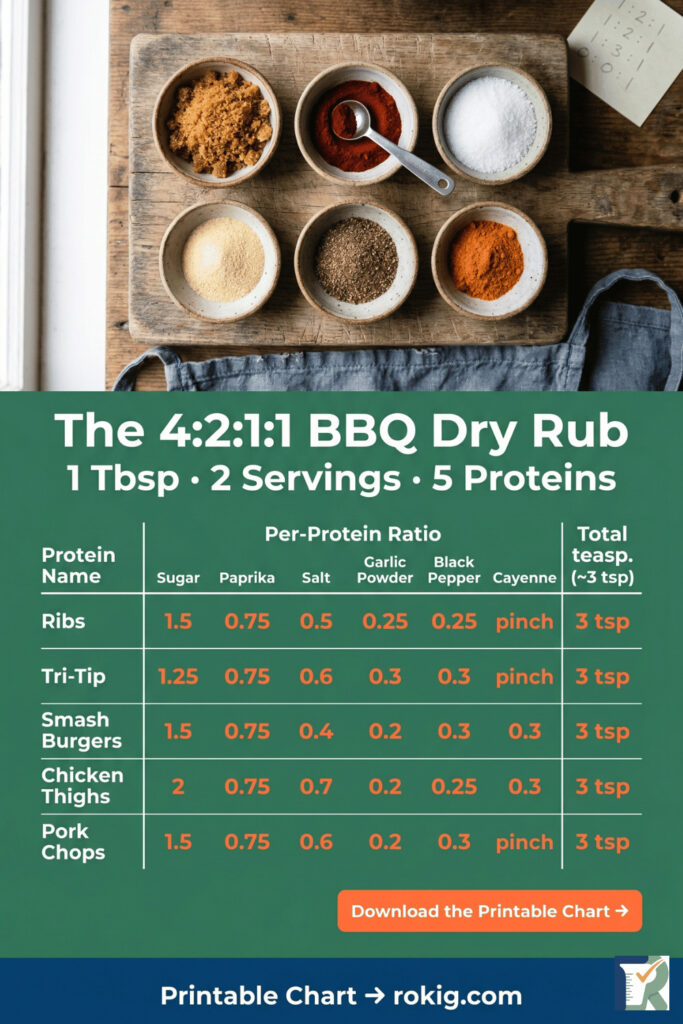
| Protein (2 servings) | Dry Rub Total | Application Timing | Expected Bark |
|---|---|---|---|
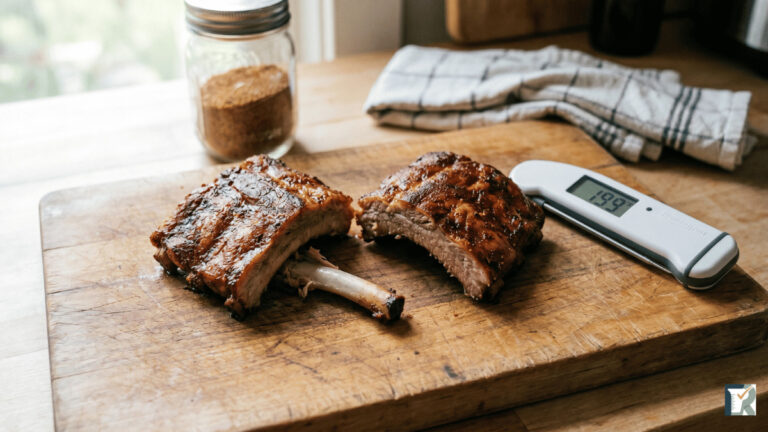
| Baby back ribs (½ rack) | 3 tsp (1 tbsp) | 30 min before cooking | Deep, firm crust |
| Tri-tip (2 portions, ~6 oz each) | 3 tsp (1 tbsp) | 45 min before cooking | Thick, chewy bark |
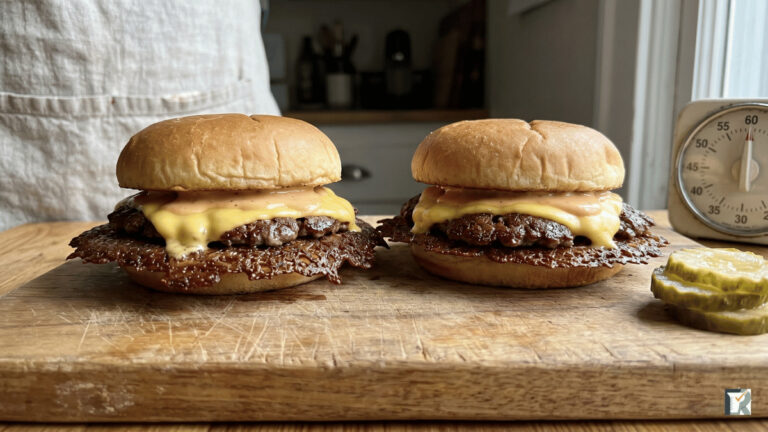
| Smash burger patties (2 × 3 oz) | 2 tsp | Immediately before cooking | Light caramelized crust |
| Chicken thighs (2 bone-in) | 3 tsp (1 tbsp) | 15 min before cooking | Glossy, lacquered skin |
| Pork chops (2, ¾-inch thick) | 2½ tsp | 10 min before cooking | Thin, spiced crust |
Application Guide — When and How to Apply (Timing by Protein)

Applying a dry rub correctly is as important as formulating it correctly. The timing determines how deeply the salt penetrates the protein surface and how well the bark adheres during cooking. The foundational step — regardless of protein type — is patting the surface completely dry with paper towels before any rub goes on.
Surface moisture prevents bark formation: the rub sits on a water layer rather than contacting the protein directly, and the bark peels away during cooking instead of adhering. Once the surface is dry, apply the measured rub and press it in using firm, flat pressure. This is the pat-don’t-rub technique: you are pressing the rub into the surface fibers, not dragging it across them. Dragging removes more rub than it deposits — the result is uneven coverage and a significantly thinner bark layer than you started with.
Timing by protein reflects the relationship between resting time, salt penetration depth, and surface moisture redistribution. Ribs have a dense surface that benefits from extended resting: 30 minutes minimum allows the salt to draw moisture to the surface, which dissolves into the rub and creates a tacky adhesion layer.
Tri-tip benefits from even longer resting — 45 minutes — given its thickness. Smash burgers are the exception: the patty surface is too thin for pre-resting to add value. Apply immediately before the patty hits the basket. Chicken thighs need 15 minutes to allow the salt to penetrate the skin layer. Pork chops sit at 10 minutes — enough for surface adhesion, short enough that the salt doesn’t begin drawing out interior moisture prematurely.
The Pat-Don’t-Rub Technique (Why Pressure Matters for Bark Adhesion)
Bark adhesion is a contact sport. The rub adheres to the protein through two mechanisms: salt-induced surface tackiness and direct physical pressure. The pat technique maximizes both. Place the measured rub on the protein surface, then press with the flat of your hand — consistent pressure, covering the entire surface area. Flip, repeat on the reverse side.
The rub should not shift when you handle the protein. If it does, the surface was not dry enough before application, or the resting time was insufficient to allow the salt to begin working. Revenons aux tolérances: it’s worth taking the extra 30 seconds to dry the surface properly. That step is the difference between bark that holds through the full cook and bark that slides off at the flip. Always confirm your protein has reached USDA recommended internal temperatures before serving.
FAQ
What is the best dry rub for an air fryer?
The best air fryer dry rub uses brown sugar as its base rather than white sugar. Brown sugar resists over-caramelization in dry convection heat at 375–400°F. A balanced 4:2:1:1 ratio — sweet, smoky, salty, and spiced — produces consistent bark formation across all air fryer proteins. Avoid generic grill rubs designed for low-and-slow environments; their sugar ratios are calibrated for a different temperature profile and significantly more ambient moisture than an air fryer produces.
How do you make a small batch dry rub?
Combine brown sugar, smoked paprika, salt, garlic powder, black pepper, and a pinch of cayenne in a 4:2:1:1 ratio. For two servings, the total yield is one tablespoon. Measure directly into a small bowl, mix thoroughly, and apply immediately. No jar, no batch storage needed — mix what you use, use what you mix, and the freshness stays consistent across every cook.
What spices go in a BBQ dry rub?
A BBQ dry rub includes brown sugar (caramelization and moisture barrier), smoked paprika (color and mild smokiness), salt (flavor penetration and bark adhesion), garlic powder (aromatic base), black pepper (heat balance), and cayenne (adjustable heat level). Each ingredient has a functional role in the 4:2:1:1 structure — none are optional, though the cayenne quantity can be adjusted from a pinch up to ¼ teaspoon based on heat preference.
How much dry rub for 2 servings?
One tablespoon of dry rub is sufficient for two servings of most proteins: a half-rack of ribs, two chicken thighs, two pork chops, or two tri-tip portions. Smash burger patties take slightly less — about two teaspoons — given the smaller surface area of a thin patty. The one-tablespoon benchmark ensures full surface coverage without leftover mixture sitting in a jar and losing potency.
Can you use dry rub on chicken in an air fryer?
Yes. Apply the dry rub to bone-in chicken thighs at least 15 minutes before cooking to allow the salt to draw out surface moisture and improve bark adhesion. Cook skin-side up at 375°F. The brown sugar base caramelizes evenly on chicken skin at air fryer temperatures without burning — provided you use brown sugar rather than white. The skin should emerge glossy and lacquered, not blackened.
Sources & Methodology
The 4:2:1:1 ratio was derived from testing across five proteins — baby back ribs, tri-tip, smash burger patties, chicken thighs, and pork chops — on three air fryer models across multiple sessions. Bark formation, moisture retention, and caramelization behavior were documented per protein and per model. White sugar vs. brown sugar behavior was tested at identical temperatures and timing to establish the substitution recommendation. The following external sources informed the chemistry framework and per-protein timing data:
- Serious Eats — The Food Lab: The Maillard Reaction — Maillard browning mechanism: temperature thresholds, sugar behavior, protein interaction.
- Serious Eats — How to Make Great Barbecue Dry Rubs — Component functions, ratio frameworks, benchmark data.
- King Arthur Baking — Brown Sugar vs. White Sugar in Baking — Thermal behavior comparison; caramelization point data.
- Burn Pit BBQ / Steven Raichlen — BBQ Trends 2026 — Alternative cuts and technique adaptation; trend validation for the small-batch context.
- Food Network — Guide to Dry Rubs — Per-protein application timing; benchmark reference for standard-batch formulations.
- America’s Test Kitchen — Spice Rub Basics — Salt ratio science, rub adhesion mechanics, penetration timing data.
- USDA FSIS — Safe Internal Temperatures for Beef, Pork, Lamb, and Veal — Internal temperature benchmarks for all five tested proteins.
- Washington Times — One-Person Households Rise to 39.7 Million (Jan. 2026) — Market validation for the small-batch cooking audience size and trajectory.
What to Remember — And Where to Go Next
Three things to carry from this guide:
- Use brown sugar, not white — white sugar over-caramelizes in air fryer convection heat before the interior is done.
- The 4:2:1:1 ratio equals one tablespoon total for any two-serving air fryer protein — zero leftover mixture, zero guesswork.
- Pat, don’t rub — pressure creates bark adhesion; friction removes the coating you just applied.
Put the rub to work immediately: the air fryer baby back ribs for two is the most technically involved application of this rub and the best place to test the full 4:2:1:1 system. Or return to the complete small-batch air fryer BBQ guide for two for the full protocol from prep through plating.
Which protein are you testing this rub on first? Drop your model and I’ll confirm bark formation timing.
Assisted by AI, reviewed by our human editorial team. View our Pages : Editorial Promise / Methodology / Disclaimer. This article is for informational purposes only and does not constitute medical or nutritional advice.