Small Batch Cornish Pasty: The Leak-Proof Method for Two


Craving a classic savory hand pie without dealing with a dozen leftovers or a notoriously soggy bottom? Scaling a traditional Cornish pasty down for a one- or two-person household requires precise moisture control. The secret isn’t just in the crust—it lies in a specific pre-chill technique that stabilizes the beef and vegetable filling before it ever hits the heat. Here is the tested method to achieve a flaky, structurally sound pasty in a compact kitchen setup.
- No leftovers: Calibrated exactly for 2 hearty portions.
- Moisture control: Pre-cooking the filling prevents the dreaded soggy base.
- Appliance friendly: Tested for both standard mini-ovens and Air Fryers.
The Small-Batch Pasty Reality: Why Most Recipes Fail
Have you ever spent an hour prepping a beautiful pastry, only to pull it out of the oven sitting in a puddle of its own juices? It’s incredibly frustrating. When you take a standard recipe meant to feed eight and simply quarter the ingredients, the moisture ratio often gets thrown off. The root of the problem is water retention in the root vegetables (like swede/rutabaga and potatoes) and the beef.
In a commercial bakery, high-heat deck ovens flash-bake the bottom crust before the liquid can penetrate. In a home kitchen—especially if you’re using a smaller appliance—we don’t have that immediate conductive heat. Last month, I tested a direct scale-down of a pub-style pasty. The first batch resulted in a total blowout. The filling was too wet, and the steam had nowhere to go, destroying the structural integrity of the shortcrust at minute twelve.

Here’s the thing: you have to manage the internal temperature and the liquid runoff before the assembly phase. Let’s look at the exact steps to engineer a reliable, small-batch pasty.
The Leak-Proof Method: Temperature and Moisture Control
Step 1: The Pre-Cook and Chill Phase
Unlike traditional methods that seal raw ingredients in the dough, we are going to extract the excess water first. Dice your skirt steak, potato, rutabaga, and onion into uniform half-inch pieces. Sauté them briefly just until the meat browns and the vegetables release their initial water. You must then chill this mixture in the refrigerator for 45 minutes. If the filling is even slightly warm when it touches the pastry, the butter will melt prematurely, ruining the flaky layers.
Step 2: Pastry Handling for Two
For two portions, you only need a small disc of shortcrust pastry. You can use store-bought all-butter dough if you’re short on time, but handle it as little as possible. Roll it out to exactly 1/8 inch (3mm) thickness. If it gets too thin, the gravy will breach the wall. Use an inverted 8-inch bowl to cut two perfect circles.
Step 3: The Structural Crimp and Vent
Place half of the chilled filling on one side of each circle. Fold the dough over and pinch the edges firmly. The crimp isn’t just decorative; it’s a structural seal. Most importantly, you must cut a 1-inch slit in the top of the pastry. This is your steam vent. Without it, the pressure will force the seal open.

Troubleshooting & Air Fryer Adjustments
Small appliances change the baking dynamic. While a standard oven provides even, ambient heat, an Air Fryer uses aggressive top-down convection. Here is what we found during our bench tests.
What Went Wrong in Testing
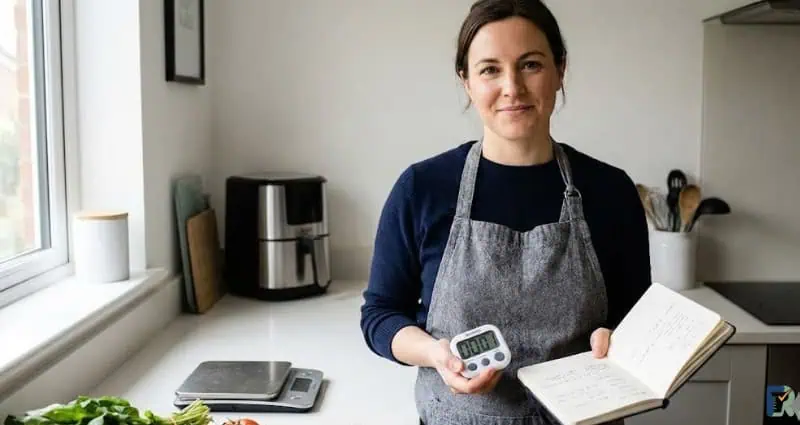
June’s Test Notes: During our Air Fryer trials using a 6-quart basket model, baking the pasty at the standard 400°F caused the top crust to burn before the internal beef mixture reached a safe temperature. The pastry was deeply browned at 10 minutes, but the center was only 110°F. We had to lower the temperature and extend the time to balance the bake.
If This -> Do That (Matrix)
- Issue: Pale, soggy bottom. -> Solution: Ensure you are baking on a pre-heated baking sheet or using the metal crisper plate in your Air Fryer to conduct heat directly to the base.
- Issue: Filling leaking from the sides. -> Solution: The crimp was too loose, or you overfilled the pastry. Stick to exactly 3/4 cup of filling per pasty.
- Issue: Top browning too fast. -> Solution: Tent loosely with a small square of aluminum foil for the final 10 minutes of the bake.
Core Data & Baking Matrix
To ensure perfect results, rely on temperature, not just time. The interior of the pasty must reach a safe temperature, and the crust must be fully set.
Standard Mini-Oven: Bake at 375°F (190°C) for exactly 35-40 minutes.
Air Fryer (Basket Style): Air fry at 340°F (170°C) for 22-25 minutes, flipping halfway if your model relies heavily on a single top heating element.

Small Batch Cornish Pasty for Two

Ingredients
For the Pastry:
- 1 cup All-purpose flour
- 1/4 tsp Salt
- 4 tbsp Unsalted butter cold, cubed
- 2-3 tbsp Ice water
- 1 Egg beaten, for egg wash
For the Filling:
- 6 oz Skirt steak or sirloin diced small
- 1/2 cup Potato peeled and finely diced
- 1/3 cup Rutabaga/Swede peeled and finely diced
- 1/4 cup Yellow onion finely diced
- 1/4 tsp Kosher salt
- 1/4 tsp Black pepper
Instructions
- Make the pastry: Rub the cold butter into the flour and salt until it resembles coarse breadcrumbs. Add ice water 1 tablespoon at a time until the dough just comes together. Wrap and chill for 30 minutes.
- Sauté the filling: In a skillet over medium heat, briefly sauté the beef, potato, rutabaga, and onion for 4-5 minutes until the beef browns and vegetables release their moisture. Season with salt and pepper.
- Chill the filling: Transfer the mixture to a bowl and refrigerate for 45 minutes until completely cold.
- Roll and assemble: Divide the chilled dough in half. Roll each into an 8-inch circle (1/8 inch thick). Place half the filling on one side of each circle.
- Seal and vent: Fold the dough over the filling. Crimp the edges tightly to seal. Cut a 1-inch slit in the top of each pasty. Brush with beaten egg.
- Bake: Bake at 375°F (190°C) in a preheated oven for 35-40 minutes until golden brown. Rest for 10 minutes before eating.
June’s Tips
FAQ
Can I use store-bought puff pastry instead of shortcrust?
Yes, but with a caveat. Puff pastry is richer and flakier, but it lacks the structural density of a traditional shortcrust. If you use puff pastry, you must ensure the filling is exceptionally dry, or the bottom layers will turn gummy rather than crisp.
How do I reheat a leftover pasty without a microwave?
To maintain the crisp texture, avoid the microwave entirely. Reheat the pasty in an Air Fryer at 320°F (160°C) for 8 to 10 minutes, or in a toaster oven until the internal temperature reaches 165°F.
Why did my pasty shrink in the oven?
Shrinkage happens when the gluten in the pastry dough is overworked and hasn’t had enough time to rest. Always let your rolled-out dough rest in the refrigerator for at least 15 minutes before adding the filling and baking.
Do I have to use rutabaga (swede)?
While rutabaga is traditional for a Cornish pasty, you can substitute it with carrots or extra potatoes. Keep in mind that carrots hold less water, which actually makes the filling slightly easier to manage for beginners.
Can I freeze these pasties raw?
Yes, freezing them raw is the best way to meal prep. Assemble the pasties, freeze them solid on a baking sheet, and then transfer to a freezer bag. Bake directly from frozen, adding about 10-15 minutes to your total cooking time.
Sources & Methodology
We tested this small-batch recipe using two different appliance types: a standard Breville Smart Oven Pro and a 6-quart Instant Vortex Air Fryer. The moisture retention of the filling was weighed before and after the pre-cook phase to determine the optimal reduction. Internal temperatures were verified using a calibrated instant-read thermometer, ensuring the beef reached the USDA recommended minimum internal temperature of 145°F with a 3-minute rest, though our bake times generally take the filling to 165°F for optimal vegetable tenderness.
If you’re ready to tackle this, grab your kitchen scale and start with the vegetable prep. Controlling those variables early on guarantees a clean, reliable bake.

Assisted by AI, reviewed by our human editorial team. View our Pages : Editorial Promise / Methodology / Disclaimer. This article is for informational purposes only and does not constitute medical or nutritional advice.